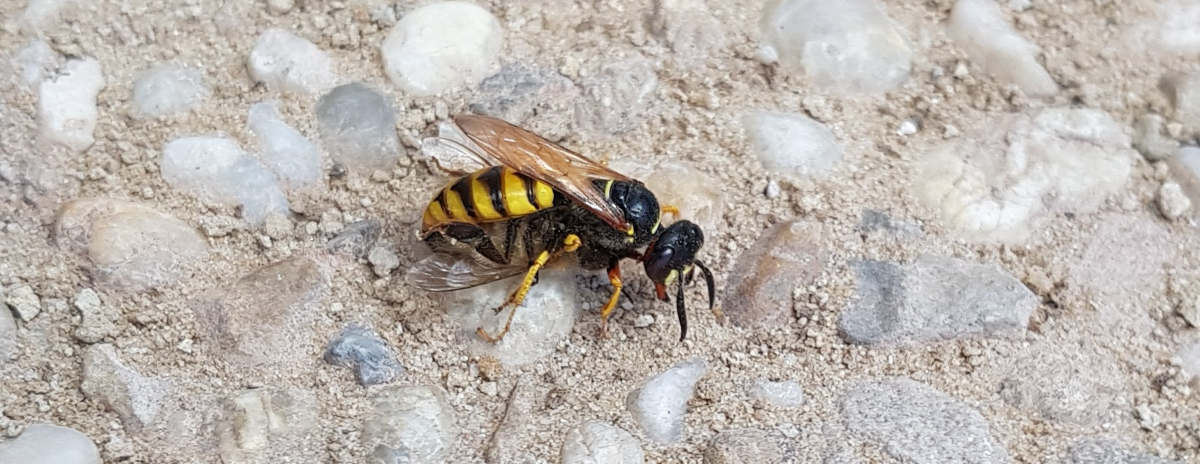
This is a European beewolf.
If you saw it making low passes around your garden, you might hurry out of its way, or think "is that a fat wasp or two mating ones?" before moving on with your life.
But there's a lot of drama happening.
This beewolf happened to be carrying a paralysed honey bee. The bee had been on its way to drink nectar from flowering oregano plants, where its friends were already gorging themselves. It didn't notice the beewolf, who had gotten close enough to smell the bee's cuticular hydrocarbins and confirm that the target was indeed a bee. As the bee went to settle on one of the pink flowers, the beewolf launched itself down at the bee and grabbed it before it even had a chance to land.
As the beewolf wrapped its legs around the honey bee, the bee tried to frantically stab at her assailant with her venomous stinger. Bees have been flying out in the open for millions of years, they can do so because they can defend themselves. But the beewolf has her own defence, a thick and smooth chitinous exoskeleton. They honey bee struggles in vain, while the beewolf slips her stinger in the articular membranes behind the bee's front legs, paralysing it.
At this point, the bee becomes a passive observer. Physically passive, anyway. We have a hint of what may be going on in the tiny bee's brain. In lab settings, honey bees exposed to simulated predatory attacks show neurochemical shifts which mirror that of mammals when they are experiencing acute anxiety or depression. It may look dead, but it's still seeing, smelling, detecting touch. Only its muscles are paralysed.
The bee is brought to the beewolf's burrows. Not a bustling wasp nest. The beewolf is a solitary wasp, and digs burrows in sandy soil. You could mistake these for ant tunnels. For a little while, the beewolf hovers over the entrance. It takes a bit longer than usual, because someone has moved the bucket that was four inches to the west of it. The beewolf is lining up the visual orientation of objects near the nest to how they were arranged when she left.
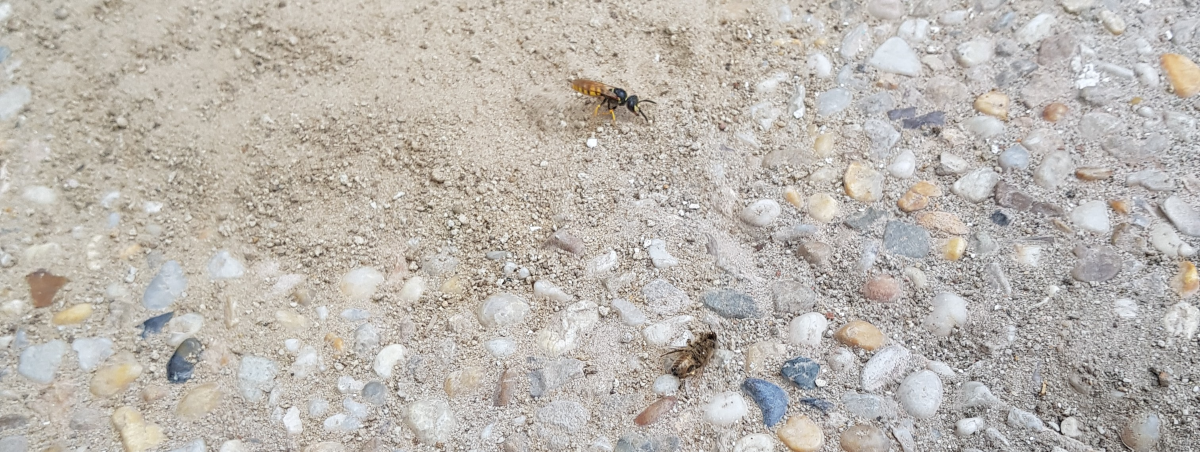
Minutes later, she drops the bee nearby and searches the entrance by close inspection. The bee might sense it's free, but it's still immobile. The beewolf finds the entrance, recognising the shape of the sand plug she'd used to close it. Returning with the bee, she opens the entrance and slowly drags the bee down the dark tunnel to the branching burrows where her larvae are wriggling in their humid brood cells. This is where the bee's journey continues for up to two weeks in lonely, unseen horror.